In 2026, a travel booking engine is no longer evaluated by features alone.
Scalability determines whether the platform supports long-term business growth or becomes an operational bottleneck.
DEFINING SCALABILITY IN TRAVEL BOOKING
Scalability means the ability to:
• Handle increasing transaction volumes
• Integrate new suppliers
• Support new markets
• Maintain performance and reliability
True scalability is architectural, not cosmetic.
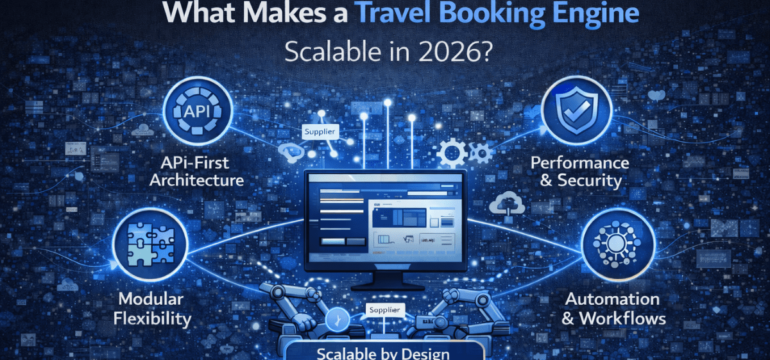
API-FIRST ARCHITECTURE
API-first systems enable:
• Real-time supplier connectivity
• Faster integrations
• Reduced technical debt
• Future adaptability
Booking engines without strong APIs struggle to evolve.
MODULAR SYSTEM DESIGN
Modularity allows businesses to:
• Add features without disruption
• Customize workflows
• Scale selectively
This reduces risk and accelerates innovation.
AUTOMATION AND INTELLIGENT WORKFLOWS
Automation powers:
• Booking confirmations
• Pricing synchronization
• Inventory updates
• Reporting
Intelligent workflows reduce manual intervention and operational costs.
PERFORMANCE, SECURITY, AND RELIABILITY
Scalable engines must maintain:
• Fast response times
• High availability
• Secure transactions
Infrastructure resilience is non-negotiable.
DATA, ANALYTICS, AND FUTURE READINESS
2026-ready engines integrate analytics and intelligence.
Data-driven insights support decision-making and growth.
CONCLUSION: SCALABILITY IS A COMPETITIVE ADVANTAGE
A scalable travel booking engine is not a tool — it is a growth platform.
Businesses that invest in scalable architecture gain long-term control and confidence.




There are no comments